
Patagonia Retrospective 1940s
Reprinted by permission of the Patagonia Regional Times. Written by Sarah Jo Peterson
Patagonia and Santa Cruz County in the 1940s
Patagonia Retrospective: the 1940s, a series of arts and cultural events during April and May 2026, celebrates and commemorates the art, culture, and history of the decade. What was it like to live in Patagonia and Santa Cruz County in the 1940s? The decade transformed communities small and large across Arizona, but the transformations were not all the same.
Cattle, Mining, and Tourism
In many ways, life in Patagonia and Santa Cruz County in 1940 epitomized life in Arizona, by population a small, majority rural state. Ranching, mining, and tourism dominated the economy.[i]
Fewer than 2,000 people lived in eastern Santa Cruz County in 1940.[ii] Patagonia was the largest of the area’s unincorporated communities, which included mining villages in Harshaw and Duquesne. Sonoita and Elgin had their own postmasters.
Mining, although hit hard by the Great Depression, had survived. A dozen or more mines were still active in the area, and Patagonia was home to the Arizona Small Mine Operators Association.[iii] Mining companies loaded their silver, lead, zinc, and copper onto rail cars near the rail depot (now Patagonia’s town hall) to ship them east.
Santa Cruz County celebrated ranch life in 1940 at the 16th annual 4th of July rodeo and the 25th annual county fair in October. Hosted in Sonoita by the Santa Cruz County Fair and Rodeo Association, both featured horse racing and rodeo events. The fair promised to be the biggest and best yet, with a visit by the Governor and a performance by the University of Arizona band.[iv]
The Circle Z Ranch (founded in 1926), already a nationally renowned “guest ranch,” offered visitors a taste of the Old West then popular in movies and books. In addition, many of the working ranches in Patagonia, Elgin, and Sonoita hosted paying guests.[v] Tourists could also stay at Patagonia’s hotel, and one of its service (gas) stations provided an “auto court,” an early version of a motel.
Rural life in 1940 still meant going without modern amenities. In Nogales, then a small city of just over 5,000 people, more than 3 out of 4 houses had running water, a flush toilet, and electric lights. In Santa Cruz County’s rural areas, fewer than half had the same. For ranch houses, only 1 in 4 had electric lights. Most rural families cooked on a wood stove.
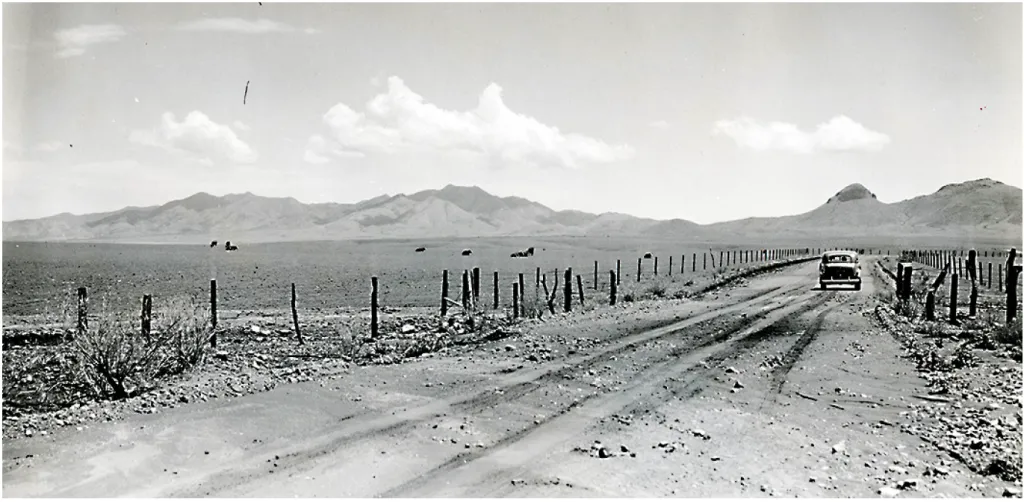
State Route (SR) 82 was mostly an unimproved dirt road, which made connecting to the outside world slow and bumpy.[vi] The news in 1940 that the state would finally upgrade it to gravel with sealant—what locals called “oiling the road”—was met with much excitement. Road construction continued through 1946.
State Route 82 was a dirt road before modernization in the 1940s. “State Route 82, Northeast of Patagonia,” U.S. National Archives (NAID: 169151427; Local ID: 30-N-39-4839), https://catalog.archives.gov/id/169151427.
Ironically, the sorry state of the highway probably fostered local businesses. Patagonia had a grocer, a dairy, and corner stores with general merchandise. There was a postmaster, a forest service office, and building and construction trades, including the Patagonia Lumber, Electric Service & Supply Co. However, the nearest bank and movie theater were in Nogales.[i]
Rural areas could provide opportunities for women. Dr. Eva Henderson practiced medicine, and Mrs. FE Betchell was the proprietor of a drug store and confectionery.[ii] Patagonia, Elgin, and Lochiel had elementary schools, and Patagonia was home to the high school, although a typical rural student left school at age 16.
Radios had transformed rural living.[iii] Across Santa Cruz County, 2 out of 3 homes had a radio in 1940, and even ranches without electric lights invested in radios. Their batteries, which were similar to today’s car batteries, could be recharged via a diesel generator or windmill.[iv] Radios brought breaking news and livestock prices, weather reports, sports events, concerts, plays, and advertising directly into people’s homes.
Radio also allowed President Roosevelt to speak directly to the American people. In his fireside chat on December 9, 1941, two days after the bombing of Pearl Harbor, he told Americans: “We are now in this war. We are all in it–all the way. Every single man, woman, and child is a partner in the most tremendous undertaking of our American history.”[i]
A County and Nation at War
War came early to Santa Cruz County. As the Nazis posted victory after victory in 1939 and 1940, demand for metals skyrocketed, and Patagonia’s mines saw increased investment and employment.[ii] In addition, wealthy Americans, cut off from their European excursions, filled Arizona’s guest ranches.
Alongside the county’s economic boom were the first rumblings of the larger changes ahead. Increased border security disrupted the flow of workers and shoppers across the border. At a time when 1 in 4 county residents were foreign born, mostly in Mexico, the federal government required the registration of all resident aliens.
The first peacetime draft in U.S. history began in September 1940, requiring that men ages 21-36 (later 18-65) register with their local draft boards. During the war years, 1,505 men and women tied to Santa Cruz County served in the military.[iii] This equaled nearly 16% of the county’s 1940 population.
The U.S. military surrounded Santa Cruz County, although they did not maintain much presence within its borders. Across the eastern border in Cochise County, Fort Huachuca in 1940 was Arizona’s largest military installation and home to Buffalo Soldiers, a regiment of Black enlistees. The Army began a massive expansion of Huachuca in late 1940, ultimately building a base for 25,000 people—at the time equivalent to the third largest city in Arizona. It was a supply depot for southern Arizona and eventually an infantry training facility.[iv]
Since the military imposed racial segregation, the vast majority of those stationed at Huachuca were Black men and women. The war’s contradictions were not lost on Black Americans who supported the war effort under the banner of the Double V campaign: victory for democracy abroad and at home. Although Huachuca was designed to be self-contained, its inhabitants traveled outside the base for recreation, including to Nogales.
But it was the rise of air power that truly transformed southern Arizona. Army Air Fields in Tucson, Douglas-Bisbee, and Hereford trained thousands on B-24’s, B-25’s, and B-29’s.[v] The Navy even trained pilots for a time at Nogales International Airport.[vi] Training requires flying: being out and about in southern Arizona would have meant encountering jittery pilots on their first flights and massive, loud bombers, sometimes flying low.
Probably because of the large military presence, the federal government designated southern Arizona part of the west coast exclusion zone for people of Japanese descent, including Japanese Americans. However, the state’s proximity to California made it an attractive location for several large relocation camps and smaller isolation camps north of the exclusion line.[vii]
Today we quite rightly remember the unjust treatment of Japanese Americans and Black Americans during WWII. At the start of the war, many Americans had significant prejudices across religions, races and ethnicities, and income classes. The federal government set out to convince Americans—and the world—that our diversity was strength.[viii] Its efforts included reaching out to its Spanish-speaking citizens in Spanish.[ix]
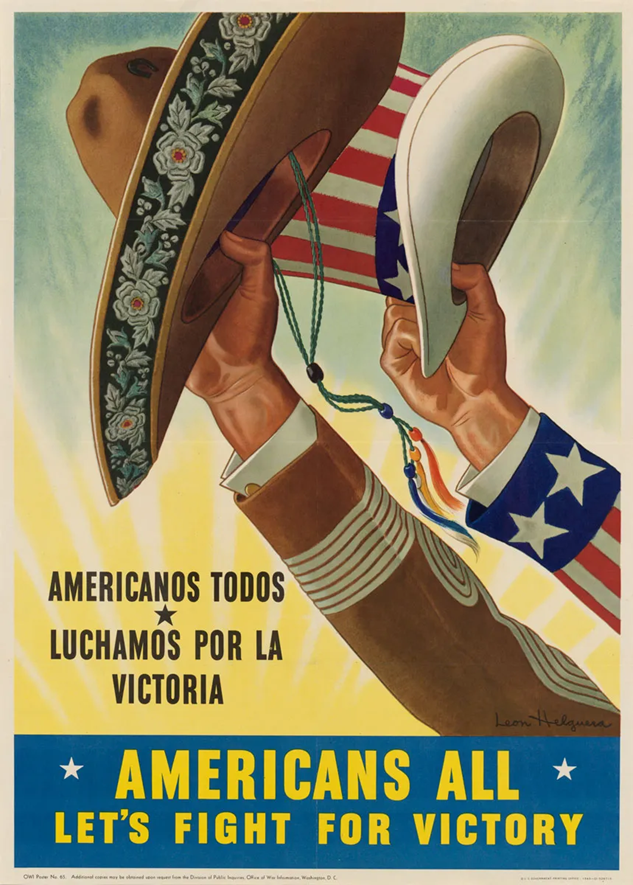
Office of War Information, Americans All: Let’s Fight for Victory/ Americanos Todos: Luchamos Por La Victoria, U.S. National Archives (NAID 513803, Local ID 44-PA-353).
With U.S. entry into war, the federal government severely restricted what was now the “civilian” economy. Entire categories of business and employment were declared “nonessential.” Industrial areas boomed with war production contracts. Millions of American men and women moved to northern and western states and from rural areas to manufacturing cities. They served the war effort building ships, tanks, bombers, and other necessities of war.
Full employment and industrial wages brought wartime prosperity, although it was a weird sort of prosperity because there was little to buy but war bonds.

Sugar was still rationed when Mrs. Turner shared her recipe for Soup to Nuts Cake in 1946. Arizona Cattlelog, October 1946, https://azmemory.azlibrary.gov/nodes/view/256662?.
War shaped daily life. Rationing of tires and gasoline affected how and where you traveled. Rationing of sugar, meat, and other foodstuffs, changed what you ate.[i] The scarcity of building supplies, home goods, and mechanical equipment meant you made do with what you had. War was on the radio and at the movies, and the Red Cross held fundraising dances, including in Patagonia and Elgin. The March 1943 Red Cross dance at Elgin featured musicians from Fort Huachuca.[ii]
Service flags were constant reminders of those who were absent. Designed to be hung in windows or on a wall in homes, businesses, or other places people gathered, a blue star signified someone in the military and a gold star someone who had died for their country.[i]
The Ultimate Sacrifice
Death came to Santa Cruz County on the first day of the war. James William Horrocks of Nogales was among the eight Arizonans killed in the sinking of the USS Arizona at Pearl Harbor. By war’s end in 1945, the county had lost 54 men and one woman.[ii] Although it is not possible to tell all their stories, here are two with ties to Patagonia who made the ultimate sacrifice.
Private Lona Young, 21, had enlisted in the Women’s Army Corps in 1944. She drove jeeps at Camp Hood in Texas, where she was killed in an automobile accident. At her graveside service in Patagonia, members of the American Legion fired a rifle salute and played taps. At the time she died, she had two brothers serving in the military, one in the South Pacific.[iii]
Patagonia’s William Morse Cummings enlisted in the cavalry in 1940 and sailed for the Philippines on June 6, 1941. His parents were prominent personalities in Patagonia: his father owned a café and the building that housed the Big Steer Bar. After the fall of Bataan in April 1942, his regular letters home stopped, and his panicked parents reached out to Senator Carl Hayden. The news was grim. The Japanese had most likely taken Captain Cummings prisoner.
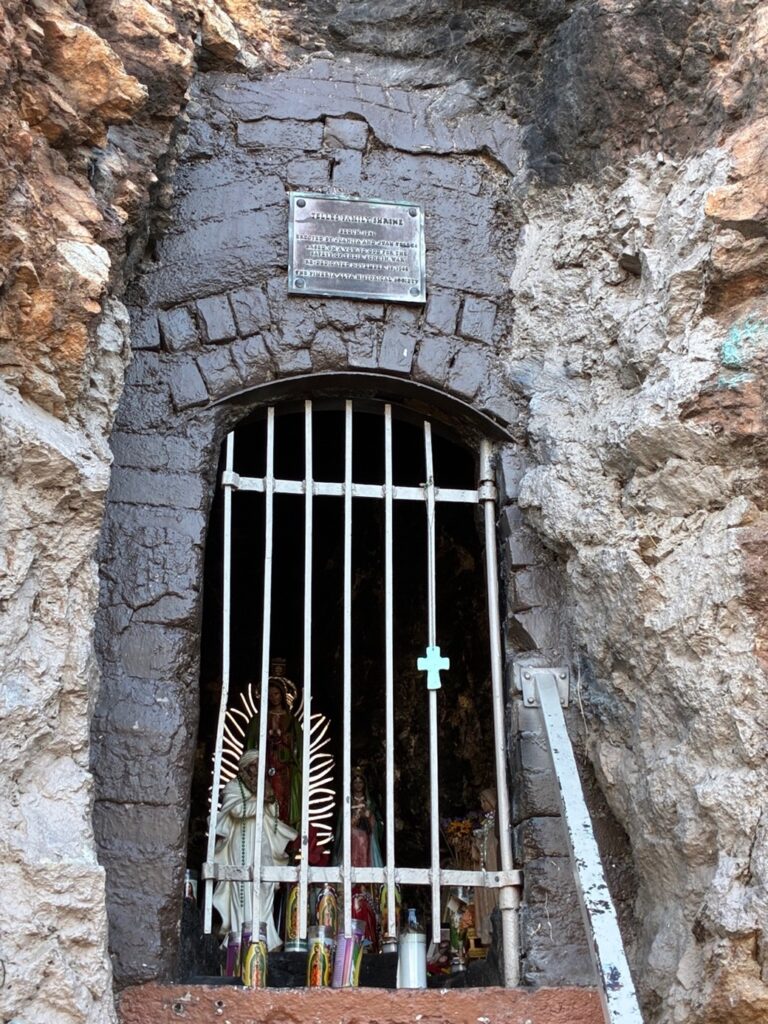
Shrine on State Route 82 constructed in 1949 by Juan Telles to fulfill his wife Jauna’s vow to God after the safe return of her sons from World War II and the Korean War. Photo: SJ Peterson
His father, C.D. “Dud” Cummings, kept up appearances, even as it approached a year with no word from his only child. After a typical Saturday night greeting friends in the bar, Dud’s sudden death of a heart attack at age 52 shocked Patagonia. Everyone blamed the stress of not knowing the fate of his son.[iv] Tragically, Captain Cummings would die a prisoner of war in December 1944.[v]
Decade’s End: Arizona Transformed
World War II transformed Arizona. Its staggering population growth—by 50%!—during the 1940s recast the state as majority urban.
Like many rural areas, Santa Cruz County did not share in the population boom. The county, including its rural areas, actually lost a little population over the decade.
However, wartime prosperity had improved life in the county, especially in its rural areas. Most striking was the arrival of rural electrification. By decade’s end most ranch houses finally had electric lights. In a typical rural home, a family enjoyed modern plumbing, no longer cooked on a wood stove, and even had a refrigerator. In addition, home ownership had increased, probably in part thanks to the federal GI Bill, first enacted in 1944.
By decade’s end Patagonia had also changed. It was now a small hub on a modern rural highway, complete with street signs and house numbers added in 1943.[1] Patagonia incorporated as a town in 1948, which earned it a count in the 1950 Census: 700 residents.
Sarah Jo Peterson is a resident of Patagonia.
[1] Brad Melton and Dean Smith, eds., Arizona Goes to War: The Home Front and the Front Lines during World War II (The University of Arizona Press, 2003).
[1] Demographic and housing data for Santa Cruz County and Arizona is from the U.S. Census, 1940 and 1950.
[1] “Twenty-Ninth Annual Report of the State Mine Inspector for the Year Ending November 30, 1940,” State of Arizona, January 7, 1941, https://azmemory.azlibrary.gov/nodes/view/112129?type=all&lsk=b9e0784ea6b8243ab36ff02c3b237616; Business and Professional Directory of Arizona, 1941-1942 (Arizona Directory Company, 1941), https://azmemory.azlibrary.gov/nodes/view/161174?type=all&lsk=b9e0784ea6b8243ab36ff02c3b237616.
[1] “County Fair Opens at Sonoita Today,” Nogales International, October 12, 1940, Arizona Memory.
[1] Arizona Highway Department, “Arizona Invites You,” [1940], https://azmemory.azlibrary.gov/nodes/view/158927?type=all&lsk=e5f4f1c3ef1a25b44201e08dea409a59.
[1] Arizona DOT, “State Route 82: Nogales to Tombstone Highway,” Arizona’s Historic Roads, 2011, https://azmemory.azlibrary.gov/nodes/view/96758?lsk=e5f4f1c3ef1a25b44201e08dea409a59.
[1] Business and Professional Directory of Arizona, 1941-1942.
[1] Business and Professional Directory of Arizona, 1941-1942.
[1] Mark Oppold, “How Radio Transformed American Agriculture,” AgNet West Radio Network, November 11, 2025, https://agnetwest.com/history-agricultural-radio-america/.
[1] June S. Macarther, “Farm Radios: Communication Before Rural Electrification,” Farm Collector, March 1, 2001, https://www.farmcollector.com/equipment/farm-radios/.
[1] Franklin Delano Roosevelt, “Fireside Chat: December 9, 1941, The American Presidency Project, accessed March 11, 2026, https://www.presidency.ucsb.edu/documents/fireside-chat-12.
[1] Ester H. Kinter, “Santa Cruz: The Miniature Empire,” Arizona Highways, February 1940, 12-13, 32-33, Arizona Memory.
[1] “1505 Names on County Honor Roll Plaque,” Nogales International, November 9, 1945, Arizona Memory.
[1] “World War II at Huachuca: 1940-1949,” Huachuca Illustrated, Volume 9, 1993, https://home.army.mil/huachuca/9816/6577/8839/Vol_9_1993_World_War_II.pdf.
[1] “Arizona Army Air Fields,” Wikipedia, updated September 11, 2025, https://en.wikipedia.org/wiki/Arizona_World_War_II_Army_Airfields.
[1] Santa Cruz County, “Nogales International Airport: Airport Master Plan,” February 2015, https://www.santacruzcountyaz.gov/DocumentCenter/View/10874/Nogales-International-Airport-Master-Plan.
[1] Gabriel Pietrorazio, “Why a pair of tribal reservations were picked to hold Japanese Americans in Arizona,” KJZZ, December 9, 2025, https://www.kjzz.org/indigenous-affairs/2025-12-09/why-a-pair-of-tribal-reservations-were-picked-to-hold-japanese-americans-in-arizona.
[1] Kevin Kruse, “Diversity is our Strength,” Campaign Trails, February 15, 2026.
[1] Daniel Dancis, “Americans All by Leon Helguera: Appealing to Hispanics on the Home Front in World War II,” The Text Message, National Archives, October 11, 2018, https://text-message.blogs.archives.gov/2018/10/11/americans-all-by-leon-helguera-appealing-to-hispanics-on-the-home-front-in-world-war-ii/.
[1] Megan E. Springate, “Food Rationing on the World War II Home Front,” National Park Service, accessed March 11, 2026, https://www.nps.gov/articles/000/food-rationing-on-the-world-war-ii-home-front.htm.
[1] “Red Cross Dance at Patagonia Mar. 20,” and “Dance at Elgin March 27,” Nogales International, March 19, 1943, Arizona Memory.
[1] “Service Flag,” Wikipedia, updated February 13, 2026, https://en.wikipedia.org/wiki/Service_flag.
[1] “They Made the Supreme Sacrifice in World War II,” Nogales International, November 9, 1945, Arizona Memory.
[1] “Nogales Wac Killed at Camp Hood, Texas,” Nogales International, September 22, 1944, Arizona Memory.
[1] “Last Rites for Prominent Patagonia Man,” Nogales International, March 19, 1943, Arizona Memory.
[1] “Captain William Morse Cummings Dies Aboard Jap Vessel,” Nogales International, August 3, 1945, Arizona Memory.
[1] Alison Bunting, “Glimpses Into Our Past: The Telles Family,” Patagonia Regional Times, December 4, 2020, https://patagoniaregionaltimes.org/glimpses-into-our-past-the-telles-family/.
[1] “Street Signs and House Numbers Put Up at Patagonia,” Nogales International, March 19, 1943, Arizona Memory.